
Category: Blog

  • The AI assistant that clicks for your customer

    E-commerce chat has learned to answer questions. The next step is already here: an assistant that moves through the store on its own — switching categories, setting filters, adding to cart and filling in forms. The customer says what they need and watches it get done on screen.

    From “here is where to click” to “consider it clicked”

    A classic chat ends its job with an answer: “washing machines are under Home Appliances, the capacity filter is on the left”. A hands-on assistant starts where that one stops — it simply does it. Type “take me to washing machines” and it opens the right listing and points out where to start. Ask for “a bike for a 7-year-old” and it sets 20-inch wheels and the right height range on the category page, then highlights the best model on the list.

    The industry calls this “agentic commerce” or “AI agents”. The name matters less than what the customer sees: they ask — and the page starts working by itself, step by step, in plain sight.

    See it live: the morele.net deployment

    Below are real screenshots of the AI Shopping Assistant on morele.net, one of Poland’s largest electronics retailers, built on AskSpot. The assistant speaks the customer’s language — here Polish, one of 200+ it supports. It starts with a simple command:
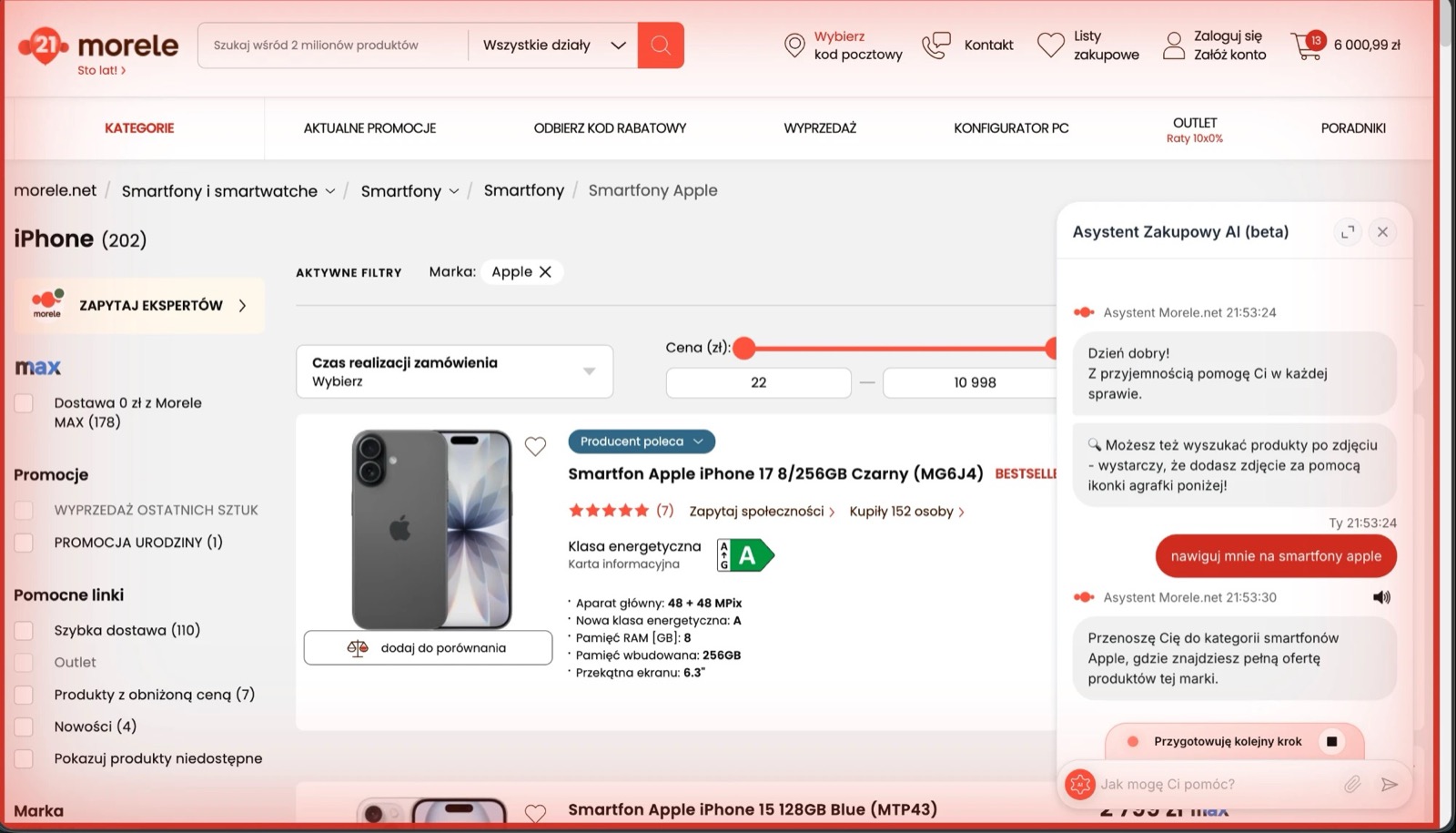
    Chat on morele.net: the command 'take me to Apple smartphones' and the assistant reply while it moves the customer to the category
    “Take me to Apple smartphones” — the assistant moves the customer to the right category and announces the next step.

    The customer narrows it down: “Show iPhone 16”. The assistant does not reply with a link to a guide — it ticks the filter on the page, exactly the way the customer would. While it works, the page dims, a frame appears around the screen, and the chat shows the status and a description of the current step:
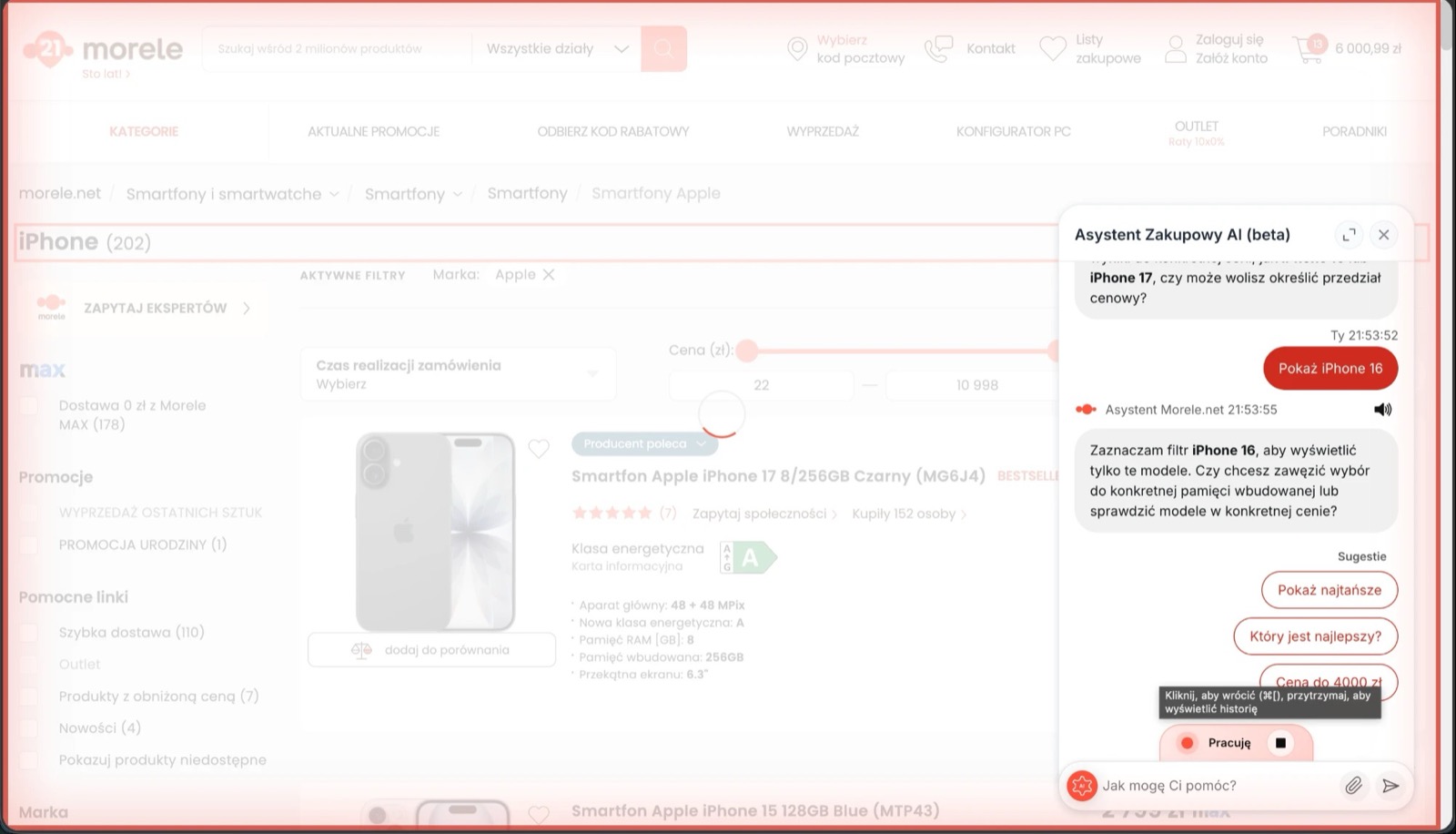
    The morele.net assistant at work: dimmed page, a frame around the screen and the message 'Ticking the iPhone 16 filter'
    The assistant at work: dimmed page, a “Working” status and a live narration — “Ticking the iPhone 16 filter”.

    Once the list is narrowed down, the assistant does not leave the customer with 53 results. It points to a specific model right on the listing and suggests ready-made next moves:
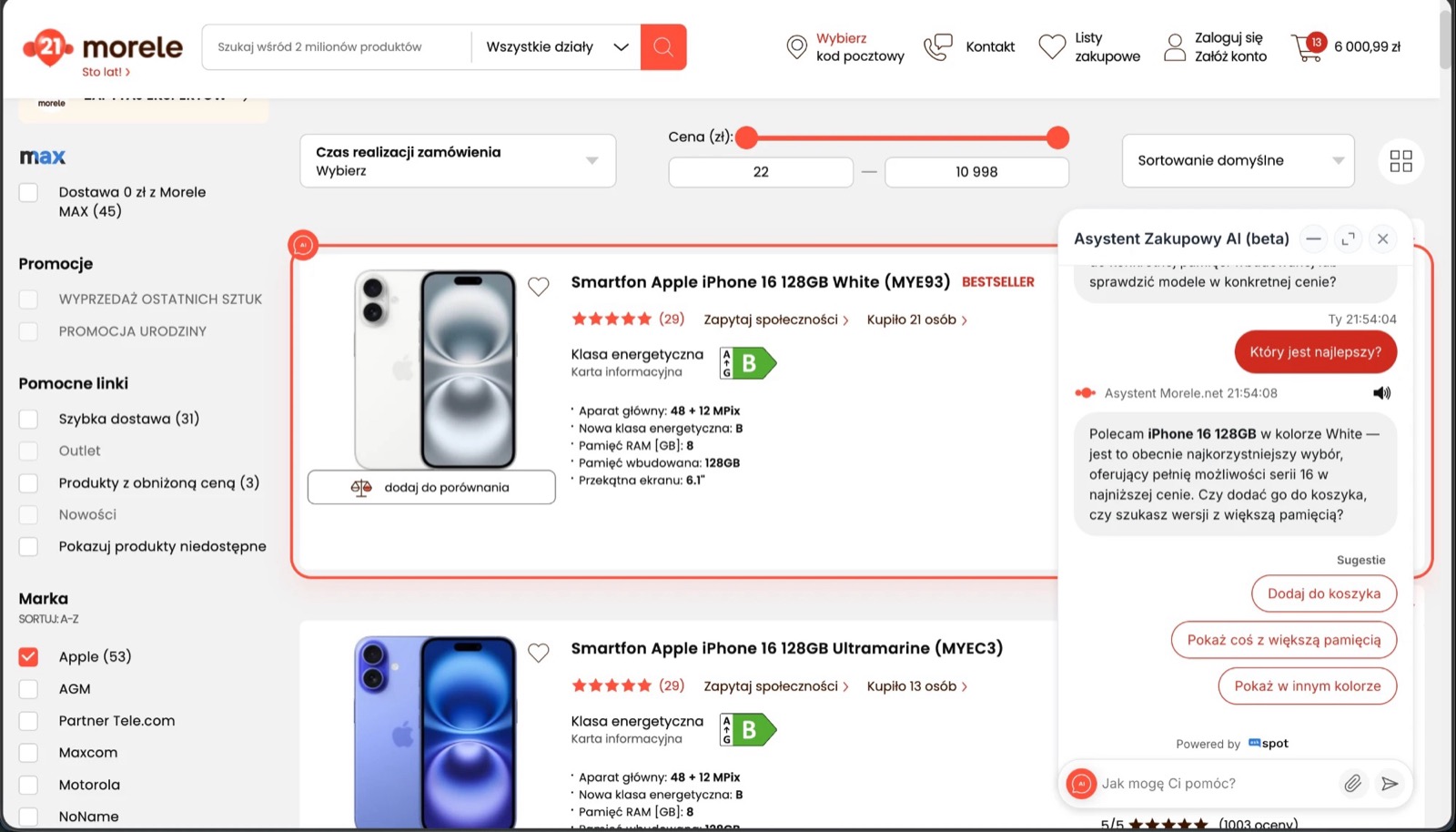
    The morele.net assistant highlights the recommended iPhone 16 on the listing and offers actions: add to cart, more storage, another colour
    The best pick highlighted on the list, with actions under the recommendation: add to cart, more storage, another colour.

    Morele.net uses AskSpot across its whole support journey — see how it cut customer service costs by 90%.

    What the assistant can handle end to end

    • set filters on a category and point out the best product on the list — “a bike for a 7-year-old”, “a built-in washing machine”
    • move the customer to the right place in the store on a single command — “take me to washing machines”
    • add a product to the cart and walk the customer through to checkout
    • fill in form data: delivery address, invoice details, contact requests
    • guide a complaint or return step by step, with no digging through the terms page
    • finish a complex task whole: “find a bike for a 7-year-old and order it to my address — card payment, courier delivery”
    Store AI assistant
    Type your question
    Powered by spot

    The assistant performs the steps on the page and narrates each one in the conversation — the customer only confirms.

    Why this lifts sales instead of just looking clever

    Most shopping journeys break not on price but on effort: filters on a phone, a form with ten fields, a cart hidden three clicks away. A hands-on assistant takes that effort off the customer — especially on mobile, where doing it yourself costs the most.

    Transparency matters just as much. The customer sees what the assistant is doing at all times: the frame signals work in progress, highlights show where the action happens, the page scrolls to the spot where something is being filled in, and the whole run can be stopped at any moment. That builds the trust without which nobody hands an AI the keys to their cart.

    The best service is the kind customers never have to learn. Here they just say what they want.

    Under the hood, in one paragraph

    The hands-on assistant is a dedicated integration with your specific store. The AI plans the steps — “open the category, tick the filter, add to cart” — and a lightweight script on the page executes them, highlighting every move. The assistant uses the page the way a person would, so it also covers processes your store has no API for. For the customer it is simply a job done; for the store, automation without rebuilding the platform.

    See the hands-on assistant on your store

    Book a short demo — we will show how the assistant navigates, filters and closes orders on your site.

  • Virtual try-on in chat: customers see the product on themselves before they buy

    In a physical store, the fitting room settles doubts. Online, customers are left guessing how a product will look on them — until now. Virtual try-on in chat lets them send a photo and see the product on themselves before they decide.

    Product photos answer the wrong question

    A product page shows the product at its absolute best: on a model with a studied silhouette, in perfect light, professionally styled. The problem is that customers don’t wonder how the dress fits the model. They wonder how it will fit them — at their height, their build, their skin tone. That question the product page never answers.

    In e-commerce, that uncertainty tends to end one of three ways:

    • the customer postpones the decision to a “later” that never comes
    • they order several sizes and variants, planning the returns upfront
    • they buy wherever it was easier to feel sure

    Customers don’t buy the product photo. They buy the image of themselves with the product — and they need to see that image, not imagine it.

    How try-on in chat works

    Everything happens in the chat window, right on the product page, with no extra app:

    1. The customer taps the paperclip in chat and sends a photo straight from their phone.
    2. The AI combines it with the product photo already on the page.
    3. A few seconds later a visualisation appears in the conversation: this product, on this person.
    4. The assistant fills in the details — length, size, colour — and asks whether to add it to the cart.
    Store AI assistant
    Type your question
    Powered by spot

    From doubt to cart — the whole journey in a single chat window.

    Friday, 10:14 pm — a real-life example

    Mia has her sister’s wedding in two weeks and fifteen browser tabs full of dresses. Each one raises the same question: gorgeous, but on me? On one of the pages the assistant offers: “Want to see this dress on yourself? Send a photo.” Mia sends a mirror selfie.

    Two minutes later she is looking at herself in three dresses — not a model, herself. The mint midi looks exactly the way she hoped. She orders one size instead of three “just in case”. The store just sold a dress at 10:19 pm — with no human involved and no discount code sent to rescue an abandoned cart.

    Why visualisation closes the sale

    The psychology is simple: as long as the product exists only in someone else’s photo, deciding takes imagination — and imagination is effort and risk. Once customers see the product on themselves, buying stops being a bet. Confidence replaces hesitation, and returns from the “not really me” category drop along the way.

    Try-on works hardest where looks decide the purchase:

    • fashion — dresses, jackets, shoes, whole outfits
    • accessories — glasses, jewellery, bags, hats
    • sport and outdoor — helmets, sunglasses, backpacks seen as part of the whole outfit

    Physical stores have always had fitting rooms. E-commerce is finally getting its own — inside the chat window.

    Not just clothes: the garden, the living room, even your wheels

    The principle is universal, because the background does not have to be a person. The customer can send a photo of any place the product is meant to live — and the AI blends it with the photo from the product page. A few scenarios that impress the most:

    • garden furniture — the customer photographs the patio and sees the rattan corner set at their place: in their light, next to their pergola and their barbecue, not in the manufacturer’s catalogue garden
    • renovation without imagination — a new front door on a photo of your own house, a paint colour on the living-room wall, flooring in the hallway
    • automotive — a set of rims “tried on” the car in the driveway; the difference between 17 and 19 inches stops being abstract
    • seasonal — a Christmas tree in the corner of the living room, straight from a phone photo: you see at once whether 220 cm clears the ceiling

    A garden furniture seller knows the customer is not buying “a rattan set”. They are buying Saturday breakfast on their own patio. The visualisation shows exactly that frame — their railing in the background — so the question changes from “will it fit?” to “which colour?”.

    Bring try-on to your store

    In AskSpot, virtual try-on is part of the AI sales assistant — the same one that advises, compares products and leads to the cart. It uses the product photos you already have, and the customer installs nothing. You switch it on where looks sell: fashion, accessories, home, garden and living.

    Try-on is one piece of a bigger shift — see also how AI increases conversion in e-commerce.

    See try-on on your own products

    Book a short demo — we will show virtual try-on and the full AI assistant on your catalogue.

  • How AI Increases Conversion in E-commerce

    Most online stores share the same frustration: they pay for traffic that doesn’t convert. Marketing budgets grow, visitor numbers climb, but sales stay flat. The reason is almost always the same — shoppers arrive before they’re ready to buy, and nothing helps them get there.

    The problem the industry knows but rarely solves

    E-commerce has become one of the most competitive spaces in digital business. Stores pour significant budgets into marketing, performance campaigns, and traffic acquisition. Yet despite growing visitor numbers, conversion remains the stubborn challenge no one wants to talk about.

    The reality is straightforward: most shoppers don’t arrive with a decision already made. They’re comparing options, weighing features, trying to figure out which product actually fits their needs. In a physical store, a sales assistant bridges that gap — shoppers can ask questions, compare products side by side, and get a recommendation before they commit. Online, they’re left alone with hundreds of products and no one to guide them. That’s where the problem starts.

    What online shoppers are actually looking for

    Most customer conversations in online stores have nothing to do with shipping or returns. Shoppers ask about products. Specifically, they want to know:

    • which product to choose when faced with several options
    • how two specific models actually differ
    • whether a product is right for their particular situation

    If they can’t get a quick answer, they leave.

    The biggest barrier to buying online isn’t price — it’s uncertainty.

    higher conversion among chat users

    59%

    of customers click recommended products

    1 in 4

    conversations end in a purchase

    How AI acts as a digital sales assistant

    Modern AI systems can analyze a product catalog, understand shopper questions, and recommend the right products in real time. Instead of clicking through page after page, a shopper can simply ask:

    • “Which laptop is best for graphic design?”
    • “What’s the difference between these two models?”
    • “What would you recommend for a beginner?”

    AI can instantly compare products, surface the most relevant options, and explain the key differences — creating an experience that closely mirrors shopping in a physical store. There’s a simple truth in sales: people rarely buy when they’re confused. They buy when they feel confident. AI builds that confidence through clear answers and relevant recommendations.

    AI Assistant
    Question text
    Powered by spot

    This is what that conversation looks like in practice — the customer asks naturally, AI clarifies and shows matching products.

    AI as part of the purchase journey, not just a chatbot

    The real difference between a basic chatbot and an AI built for e-commerce is this: one answers questions, the other guides the entire purchase journey. Rather than pointing shoppers back to filters and category pages, AI walks them through the process — from the first question, through product comparison, all the way to the moment they add something to their cart knowing it’s the right choice.

    Conversion isn’t just about driving traffic. It’s about helping shoppers make decisions. AI makes that possible at scale.

    The future of online retail is smarter conversations

    As e-commerce continues to evolve, one thing is becoming clear: the future of online retail isn’t just automation — it’s smarter conversations that help shoppers buy with confidence. By combining product knowledge, conversation context, and intelligent recommendations, AI can replicate the role of a trusted sales assistant — available to every shopper, at any time.

    See what this looks like in practice: Konesso turned 16.2% of conversations into purchases, Militaria.pl reached a 48% recommendation CTR, and Morele.net cut customer service costs by 90%.

    See how this works on your own catalog

    Book a short demo — we’ll show AskSpot on products from your store.